Acne scar treatment

Subcision, TCA CROSS, Fraxel FTX and more, matched to each scar type

Most faces have more than one kind of acne scar, and each kind responds to a different treatment. Dr. Nawas maps your scars by type and builds the plan around them.

Starts with
A $250 consultation and a map of your scars
Treatments
Subcision, TCA CROSS, Fraxel FTX, peels and Vbeam
Downtime
None to about a week, by treatment
Results appear
Over 2 to 6 months as collagen rebuilds
Typical cost
$250 to $1,800 per session

What it treats

Is this for you?

  • Rolling scars: broad, soft dips that flatten when the skin is stretched
  • Icepick scars: narrow, deep pits
  • Boxcar scars: wider dips with sharp edges
  • Red and brown marks left after breakouts
  • Red, raised and keloid scars
  • Rough texture and enlarged pores around scars

How it works

Still from the animation: a drop of TCA placed at the base of a narrow, deep icepick scar, beside a boxcar scar and a rolling scar
How TCA CROSS treats acne scars One minute, no sound
Read the steps

Three kinds of acne scars. Acne scars come in three main shapes: narrow, deep ice pick scars; wider boxcar scars with sharp edges; and soft rolling scars tethered from below.

  1. Why ice pick scars. Ice pick scars are narrow but deep, so resurfacing alone cannot reach their base. TCA CROSS treats each one individually, right at the bottom.
  2. Apply. A tiny drop of high-strength TCA is placed at the base of each scar with a fine applicator. The scar walls frost white within seconds; the surrounding skin is untouched.
  3. Heal. A small crust forms and sheds within days. New collagen then fills the scar from the bottom up, so it becomes shallower with each session, spaced a few weeks apart.
  4. Stack. Treatments are stacked for the best result: TCA CROSS for ice pick scars, subcision and filler for rolling scars, and Fraxel for boxcar scars and overall texture.
Still from the animation: a fine needle passing just beneath a rolling scar to cut the bands that tether it down
How subcision lifts rolling scars One minute, no sound
Read the steps

Why rolling scars dip. Rolling acne scars are soft, wavy dips. Beneath each one, bands of scar tissue tether the skin down to the deeper layers, like stitches pulling from below.

  1. Numb. The area is numbed with a small injection of local anesthetic, so the procedure itself is comfortable.
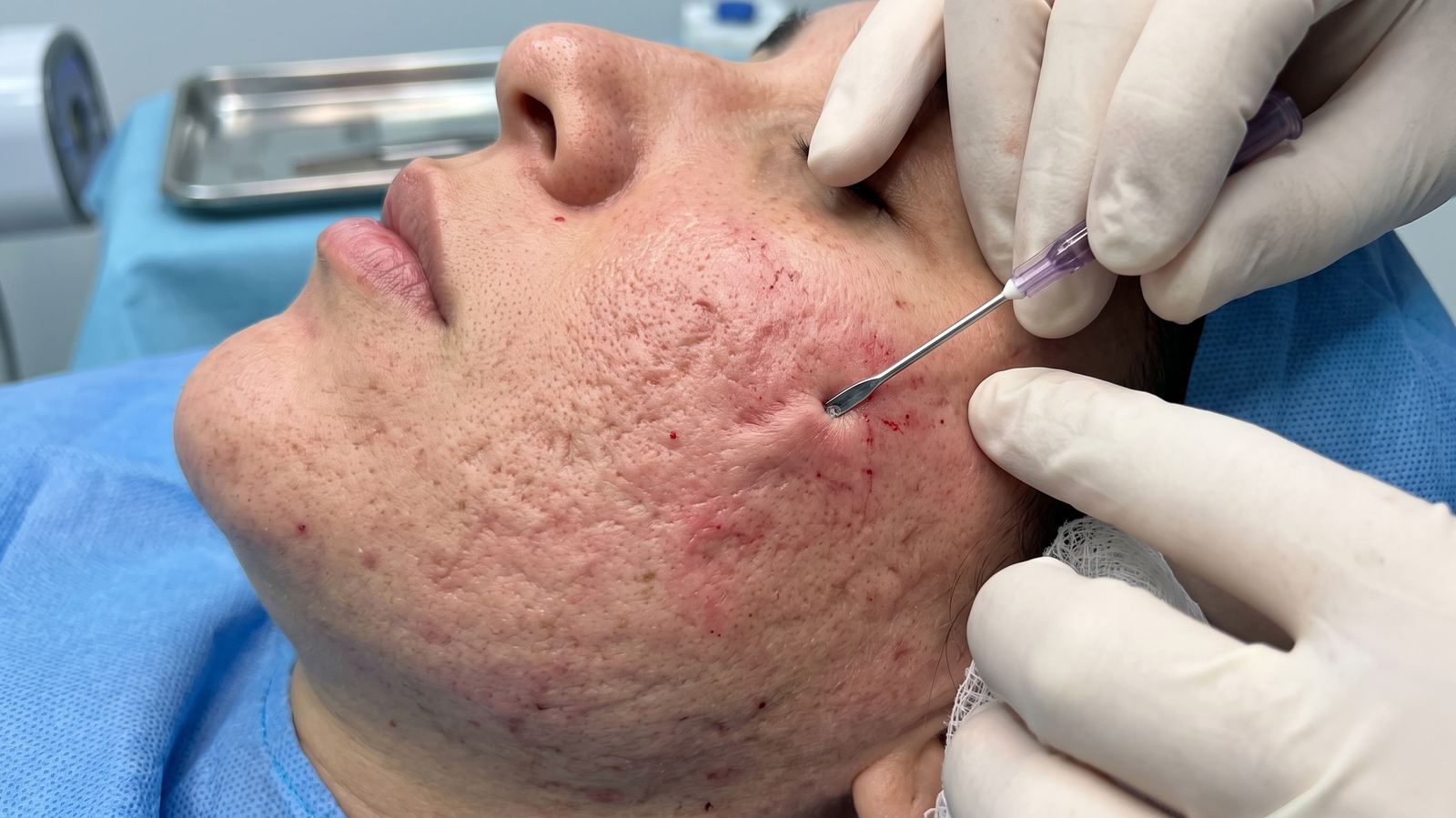
  2. Release. A fine needle slides just beneath the scar and moves gently back and forth, cutting the bands that hold it down.
  3. Lift. Freed from the bands, the scar floor rises. The small pocket beneath fills with blood, your body's own scaffold for new collagen. Bruising for a week or two is normal.
  4. Rebuild. Over the following weeks new collagen fills the pocket and holds the skin up. Subcision pairs well with filler, PRP or Fraxel for an even smoother result.
Still from the animation: a cross-section of skin under the Fraxel FTX handpiece, with narrow columns of heat reaching into the dermis
How the Fraxel FTX laser works One minute, no sound
Read the steps

What sun and time leave behind. Years of sun and time leave fine lines, uneven pigment, scars and worn collagen, in both the surface layer and the deeper dermis.

  1. Glide. After numbing cream, the handpiece glides over the skin. Cool air flows through the tip to keep the treatment comfortable.
  2. Treat a fraction. The laser creates a pattern of microscopic heat columns, treating a fraction of the skin at a time: 1927 nm in the surface layer, 1550 nm deep into the dermis.
  3. Heal. Every column is surrounded by untouched skin, so healing is quick. The surface stays sealed, with no open wound.
  4. Renew. Over the next several days the treated cells are shed. Over the following weeks the skin builds fresh collagen, so tone evens out and texture smooths.

An acne scar is the mark left where inflammation destroyed collagen, and its shape shows what holds it down. Rolling scars are tethered to the deeper tissue by bands of scar tissue, so they are released from beneath. Icepick scars are narrow tracts too deep for resurfacing to reach, so they are rebuilt from the bottom with TCA CROSS. Boxcar scars are wider and shallower, so fractional laser resurfacing softens their edges and builds new collagen around them.

Most faces have more than one kind, which is why one treatment rarely finishes the job and a plan usually combines two or three. Red marks and raised scars are different again: they are blood vessels and excess collagen, treated with the Vbeam laser and a steroid injection.

Treatment options

Every option, matched to a scar type.

Most plans combine two or three of these over several months. Each price is per session and matches the treatment's own page.

Lasers

Non-ablative fractional laser

Fraxel FTX

Best for boxcar scars, texture and the pigment around scars

Treats microscopic columns of skin at two depths and leaves the skin between them intact, so it heals in days. Its 1550 nm wavelength is FDA-cleared for acne scars. Usually a series, about four weeks apart.

Downtime
3 to 5 days of redness, then light flaking
Price
Scars up to $1,000 by size; full face $1,800

Read the full Fraxel FTX guide
Coming in early 2027

Ablative laser: CO2 or erbium

Best for deeper boxcar and rolling scars

An ablative CO2 or erbium laser removes skin rather than heating it beneath the surface, so each session does more for deep scars, with more healing time than Fraxel. It arrives at ZN Dermatology in early 2027.

Downtime
About a week
Price
Published when it arrives

Pulsed dye laser

Vbeam Pro

Best for red marks and red, raised scars

Targets the small blood vessels that keep a mark or a scar red, and helps flatten raised scars.

Downtime
A few hours of pinkness, or several days of bruising at stronger settings
Price
$250 for one scar; $500 to $1,000 for several or a larger area
Read the full Vbeam Pro guide

Chemical treatments

Focal trichloroacetic acid

TCA CROSS

Best for icepick scars and narrow, deep boxcar scars

A drop of high-strength TCA placed at the base of each scar prompts new collagen that fills it from the bottom up, over a few sessions.

Downtime
Small crusts for several days; the treated spots can stay pink or darker for some weeks
Price
$250 to $500 per session

Salicylic acid, Jessner's or TCA

Chemical peels

Best for shallow scarring, rough texture and brown marks

A peel at a depth chosen for your skin evens out the brown marks breakouts leave and refines shallow scarring and texture between other treatments.

Downtime
None to about a week, by depth
Price
$250 to $500 per session
Read the full Chemical peels guide

Procedures and injections

Release from beneath

Subcision

Best for rolling scars

Under local anesthetic, a fine needle passed beneath the scar divides the bands that tether it, and new collagen fills the space over two to three months.

Downtime
Bruising and swelling, several days to a week
Price
$500 for one area; $1,000 for both cheeks or the full face
Read the full Subcision guide

Placed in the released space

Sculptra, filler or PRP

Best for rolling scars and the volume lost beneath them

Placed beneath scars released by subcision, often the same day, to support the lift while your own collagen builds.

Downtime
Swelling for a few days
Price
Sculptra $1,100 a vial; filler $800 to $1,250 a syringe; PRP $900
Read the full Sculptra guide

Kenalog

Steroid injection

Best for thick, raised and keloid scars

A small injection into a raised scar flattens it over a few sessions, alone or with the Vbeam laser.

Downtime
None
Price
$250 per session, as an add-on

Your visit

What the appointment is like.

1

Map

Dr. Nawas examines your skin in raking light, which throws every scar into shadow, and stretches it to tell tethered rolling scars from icepick and boxcar scars.

2

Plan

She matches a treatment to each scar type and confirms the order, the number of sessions and the price with you before anything starts.

3

Treat

Subcision can often be done at the same visit. Fraxel is scheduled as its own session because of the numbing time.

4

Review

Photographs at each visit track the change, and the plan is adjusted as the scars respond.

Before and after your appointment

Simple preparation, simple recovery.

Before

  • Avoid sun exposure, tanning and self-tanner for four weeks before laser treatment.
  • Stop retinoids and exfoliating acids five to seven days before Fraxel or a peel.
  • Tell Dr. Nawas about isotretinoin use, keloids, cold sores or active acne in the area.
  • Plan around the downtime: about a week of bruising after subcision, a few days of flaking after Fraxel.

Afterward

  • After subcision: bruising and swelling for 5 to 10 days. Ice the first day, and avoid exercise for 48 hours.
  • After Fraxel: redness for a few days, then a bronzed, sandpaper-like texture as the treated skin sheds. Moisturize well and do not pick.
  • After TCA CROSS: let the small crusts come off on their own.
  • Use SPF 30 or higher every day, which also keeps healing skin from darkening.

Pricing

Transparent pricing.

Every price is per session and matches the treatment's own page. A typical plan combines two or three treatments.

ServicePrice
ConsultationNew patients, with a map of your scars$250
Subcision
One areaOne cheek, one temple, or a single tethered scar. Per session.$500
Both cheeks or the full facePer session. Most people may need 2 to 3 sessions, 6 to 8 weeks apart.$1,000
Filling the released space, same day (optional, chosen with you)
SculptraPer vial. Usually one vial for scars.$1,100
Hyaluronic acid fillerPer syringe$800 to $1,250
PRPYour own platelets, per session$900
Resurfacing
TCA CROSSPer session$250 to $500
Chemical peelPer session, depth chosen for you$250 to $500
Fraxel FTX, scarsPer session, priced by sizeUp to $1,000
Fraxel FTX, full facePer session$1,800
Red and raised scars, Vbeam Pro
One scar or keloidUp to about 5 cm, per session$250
Several scars or a larger areaPer session$500 to $1,000
Steroid injection for raised scarsKenalog, an add-on for keloids and raised scars$250

Estimates for planning. Dr. Nawas confirms your exact plan and price at the consultation, and you pay only for what is used. Cosmetic care is not billed to insurance. How insurance, superbills and financing work here.

Good to know

Questions patients ask.

Which treatment is best for acne scars?

The one that matches the scar. Rolling scars respond to subcision, icepick scars to TCA CROSS, and boxcar scars to fractional laser resurfacing such as Fraxel FTX. Most people have more than one type, so the best plan combines them.

How many sessions will I need?

It depends on the scars. Subcision is often two or three sessions six to eight weeks apart, and Fraxel for scars is usually a series about four weeks apart. Dr. Nawas gives you the number at your consultation.

Can scars be treated while I still have acne?

Active acne is treated first, because every new breakout can leave a new scar. Prescriptions are sent to your pharmacy with a GoodRx coupon, which brings most of them to about $35.

Is treatment safe for darker skin?

Yes, with the right choices. Fraxel and peels are set for your skin type, deeper skin tones are prepared with a lightening cream first, and Dr. Nawas recommends another approach when it would be safer.

When will the ablative CO2 or erbium laser be available?

In early 2027. Until then, subcision, TCA CROSS and Fraxel FTX treat the same scars, and its price will be published on this page when it arrives.

Next step

Ready when you are.

Rolling, icepick and boxcar scars, each treated with the tool that suits it, in one plan.

New to ZN Dermatology? Book a consultation: Dr. Nawas maps your scars by type and plans the treatments with you. Subcision can often be done at the same visit; Fraxel is scheduled as its own session.